Background
An increasingly connected world faces interconnected global challenges demanding global citizens who act for more peaceful and sustainable world.
The report Our Common Future, also known as the Brundtland Report (1987), enshrined the three dimensions of sustainable development, namely: economic growth, social inclusion and environmental balance. However, these dimensions alone cannot possibly reflect the complexity of current society, without culture. The 2030 Agenda adopted by the UN General Assembly integrates the role of culture, through cultural heritage and creativity, as an enabler of sustainable development across the Sustainable Development Goals.
Since heritage is our legacy from the past, what we pass on to future generations, in particular, the conservation of the natural and cultural heritage is a significant contribution to sustainable development. Every citizen of the world sharing universal enjoyment of heritage has a collective responsibility to safeguard our common asset.
Heritage sites have been damaged or destroyed as a result of direct hits, or as collateral damage related to armed conflicts, terrorism, and climate change. These challenges call for global citizens who recognize the value of heritage and put concerted efforts to protect the non-renewable resource beyond national boundaries.
Based on this global citizenship, members of global society share the accountability to strive towards a sustainable future. In doing so, there is a need to raise awareness among various stakeholders and to reflect it to policies at all levels including local and community level. Towards this end, it is important for us to improve government officials’ awareness and to enhance their capacities.
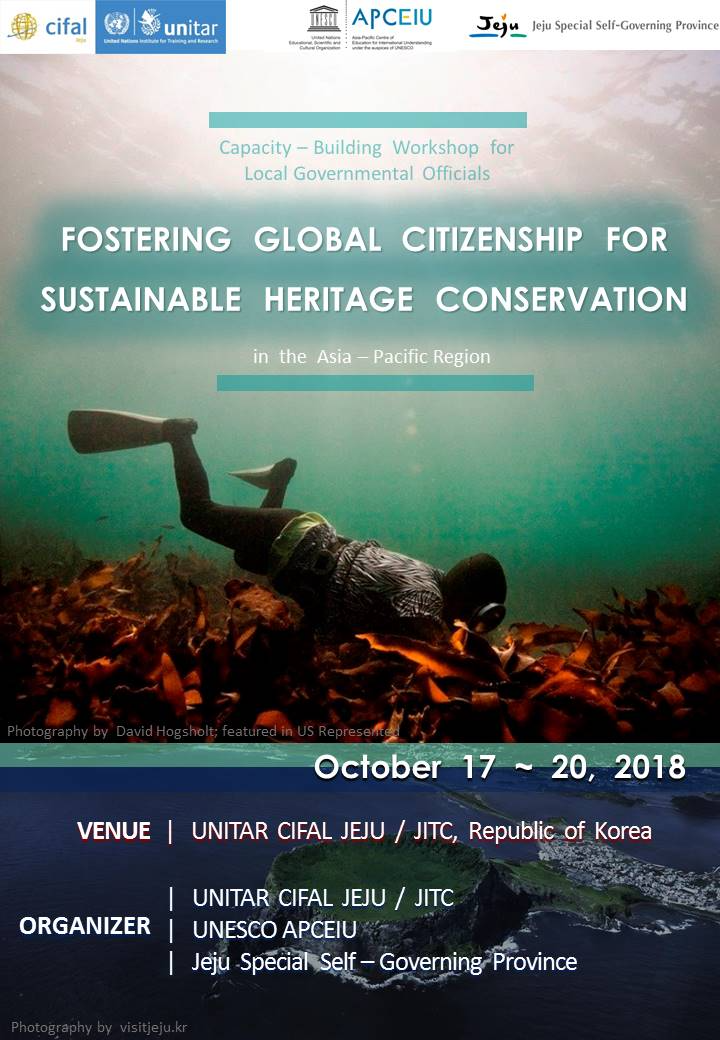
In line with this, APCEIU and UNITAR CIFAL Jeju/JITC will co-organize a 4-day workshop on Fostering Global Citizenship for a Sustainable Future in Jeju Island, a triple crown UNESCO designation. (Biosphere Reserve, World Natural Heritage and Global Geo Park) The Workshop aims to equip local government officials from the Asia-Pacific region with knowledge and skills on global citizenship; discuss how heritage conservation can be integrated with sustainable development and explore areas for potential cooperation in and beyond the Asia-Pacific region.
Event Objectives
The workshop aims to build capacity of participants from Asia-Pacific working in the areas of sustainable development, heritage conservation, global citizenship, community development and other related areas, whilst promoting awareness and recognition on the importance of promoting global citizenship. For the capacity building, this event will help the participants to:
Understand global citizenship and policy development in the context of 2030 Sustainable Development Agenda;
Utilize the lessons learned from the cases of sustainable heritage conservation policy implementation in various regions.
Have a basic understanding of heritage conservation and deepen the ideas of sustainable practices for regional/city/local development through local people’s participation;
Share the best practices of the community/local government-driven sustainable heritage conservation projects;
Understand the economic impacts of sustainable heritage conservation on the regional development, recognizing the importance of sustainable heritage conservation
Coordinate partnerships to effectively promote the benefits of heritage conservation policies with civil societies, government and local entrepreneurs
Expected Outcomes
Networks enhanced to utilize lessons learned from the cases of community building for sustainable development in the Asia-Pacific region
Action plans of participants to foster global citizenship or to facilitate integration of heritage conservation into sustainable development in their respective local settings.
Learning Objectives
At the end of the workshop, the participants will be able to:
Build the capacity of local government officials in the Asia-Pacific region to integrate heritage conservation for sustainable development
Provide local government officials with innovative and appropriate practices of heritage conservation for sustainable development
Enhance awareness and understanding of global citizenship among various stakeholders at local and community level
Utilize the lessons learned from the good cases of sustaianble heritage coservation policy implementation
Share the best practices of the community/local government-driven hertitage conservation
Understand the economic impacts of innovative start-up businesses on the urban development .
Contents and structure
The training will be composed of the following sessions:
[Session 1] Fostering Global Citizenship for a Sustainable Future
[Session 2] Understanding Global Citizenship and Sustainable Development (and SDGs)
[Session 3] Heritage Conservation in the context of Sustainable Development
[Session 4] Heritage Conservation in Jeju Island
[Session 5] Integrating Heritage and Sustainable Development by Engaging Diverse Communities for Heritage Management
[Session 6] Heritage Tourism and Community Enhancement
[Session 7] Role of Global Citizens in Supporting Local Government Heritage Conservation
[Session 8] Heritage Tourism and Community Building
[Session 9] Sustainable Heritage through Engagement of Local Communities
[Session 10] UNITAR-Developed City-Share Methodology
** Sessions are flexible to changes. **
Methodology
The training will be comprised of:
Lectures and presentations by experts
Self-assessment exercise
Group work and discussion
Action plan presentation
Visit to innovative start-up businesses
Target audiences
Central/local authorities and Representatives from NGOs, regional and community-based organizations, academic and training institutions and other local actors working in the areas of sustainable development, heritage conservation, global citizenship, community development and other related areas in the Asia-Pacific region.
** Participants should have sufficient command of both written and spoken English.
Event details
Event type : Workshop (training program)
Date: 17-20 October 2018
Venue: Jeju International Training Center, Jeju-do, ROK
Organizers:
United Nations Institute for Training and Research (UNITAR)
UNITAR CIFAL Jeju/JITC
UNESCO Asia-Pacific Centre of Education for International Understanding (APCEIU)
Jeju Special Self-Governing Province
Certificate: UNITAR, UNITAR CIFAL Jeju/JITC and APCEIU will jointly issue a certificate upon the completion of the training.
Requirements
Applicants are required to:
Submit necessary documents on time, i.e., application forms etc.
Complete and submit pre-training assignment, i.e., case study description etc.
Actively participate in the training program.
Be fluent in written and spoken English.
Application and Deadline
Send the following documents to cifaljeju.shc@gmail.com by 9 September 2018 (Sunday):
1. Application form | Download from http://www.cifaljeju.org/ |
2. Letter of nomination |
3. Letter of commitment |
4. Acknowledgement, waiver and release of liability |
5. Consent to collection, usage, and disclosure of personal information |
6. Case study description(in word file) |
7. Curriculum vitae (CV) | Your own format |
** Late application will not be accepted.
Note
Application without the required documents will NOT be considered.
Participation is subject to approval of the application by UNITAR CIFAL Jeju/JITC.
Selected applicants will be notified individually.
Assistance with travel expenses
Point of departure | Airfare Assistance Limit |
Eastern Asia | China and Japan | US$ 300 |
Mongolia | US$ 550 |
South-Eastern Asia | Brunei Darussalam, Indonesia, Malaysia, Philippines, Singapore, Thailand, and Vietnam | US$ 450 |
Cambodia, Lao PDR and Myanmar | US$ 650 |
Southern Asia | Afghanistan, Bhutan, India, Maldives and Pakistan | US$ 800 |
Sri Lanka | US$ 800 |
Bangladesh | US$ 850 |
Nepal | US$ 950 |
Pacific Islands | Kiribati, Papua New Guinea, Samoa, Tuvalu and Vanuatu | US$ 1,200 |
* Other points of departure – please contact UNITAR CIFAL Jeju/JITC |
Local expenses (transportation, accommodation and meals) during the workshop will be covered by UNITAR CIFAL Jeju/JITC and APCEIU except for arrival and departure days.
All other expenses (local transportation in their country, visa fee) should be covered by the participants.
**last update of this page- August 26th, 2018









Background
An increasingly connected world faces interconnected global challenges demanding global citizens who act for more peaceful and sustainable world.
The report Our Common Future, also known as the Brundtland Report (1987), enshrined the three dimensions of sustainable development, namely: economic growth, social inclusion and environmental balance. However, these dimensions alone cannot possibly reflect the complexity of current society, without culture. The 2030 Agenda adopted by the UN General Assembly integrates the role of culture, through cultural heritage and creativity, as an enabler of sustainable development across the Sustainable Development Goals.
Since heritage is our legacy from the past, what we pass on to future generations, in particular, the conservation of the natural and cultural heritage is a significant contribution to sustainable development. Every citizen of the world sharing universal enjoyment of heritage has a collective responsibility to safeguard our common asset.
Heritage sites have been damaged or destroyed as a result of direct hits, or as collateral damage related to armed conflicts, terrorism, and climate change. These challenges call for global citizens who recognize the value of heritage and put concerted efforts to protect the non-renewable resource beyond national boundaries.
Based on this global citizenship, members of global society share the accountability to strive towards a sustainable future. In doing so, there is a need to raise awareness among various stakeholders and to reflect it to policies at all levels including local and community level. Towards this end, it is important for us to improve government officials’ awareness and to enhance their capacities.
In line with this, APCEIU and UNITAR CIFAL Jeju/JITC will co-organize a 4-day workshop on Fostering Global Citizenship for a Sustainable Future in Jeju Island, a triple crown UNESCO designation. (Biosphere Reserve, World Natural Heritage and Global Geo Park) The Workshop aims to equip local government officials from the Asia-Pacific region with knowledge and skills on global citizenship; discuss how heritage conservation can be integrated with sustainable development and explore areas for potential cooperation in and beyond the Asia-Pacific region.
Event Objectives
The workshop aims to build capacity of participants from Asia-Pacific working in the areas of sustainable development, heritage conservation, global citizenship, community development and other related areas, whilst promoting awareness and recognition on the importance of promoting global citizenship. For the capacity building, this event will help the participants to:
Understand global citizenship and policy development in the context of 2030 Sustainable Development Agenda;
Utilize the lessons learned from the cases of sustainable heritage conservation policy implementation in various regions.
Have a basic understanding of heritage conservation and deepen the ideas of sustainable practices for regional/city/local development through local people’s participation;
Share the best practices of the community/local government-driven sustainable heritage conservation projects;
Understand the economic impacts of sustainable heritage conservation on the regional development, recognizing the importance of sustainable heritage conservation
Coordinate partnerships to effectively promote the benefits of heritage conservation policies with civil societies, government and local entrepreneurs
Expected Outcomes
Networks enhanced to utilize lessons learned from the cases of community building for sustainable development in the Asia-Pacific region
Action plans of participants to foster global citizenship or to facilitate integration of heritage conservation into sustainable development in their respective local settings.
Learning Objectives
At the end of the workshop, the participants will be able to:
Build the capacity of local government officials in the Asia-Pacific region to integrate heritage conservation for sustainable development
Provide local government officials with innovative and appropriate practices of heritage conservation for sustainable development
Enhance awareness and understanding of global citizenship among various stakeholders at local and community level
Utilize the lessons learned from the good cases of sustaianble heritage coservation policy implementation
Share the best practices of the community/local government-driven hertitage conservation
Understand the economic impacts of innovative start-up businesses on the urban development .
Contents and structure
The training will be composed of the following sessions:
[Session 1] Fostering Global Citizenship for a Sustainable Future
[Session 2] Understanding Global Citizenship and Sustainable Development (and SDGs)
[Session 3] Heritage Conservation in the context of Sustainable Development
[Session 4] Heritage Conservation in Jeju Island
[Session 5] Integrating Heritage and Sustainable Development by Engaging Diverse Communities for Heritage Management
[Session 6] Heritage Tourism and Community Enhancement
[Session 7] Role of Global Citizens in Supporting Local Government Heritage Conservation
[Session 8] Heritage Tourism and Community Building
[Session 9] Sustainable Heritage through Engagement of Local Communities
[Session 10] UNITAR-Developed City-Share Methodology
** Sessions are flexible to changes. **
Methodology
The training will be comprised of:
Lectures and presentations by experts
Self-assessment exercise
Group work and discussion
Action plan presentation
Visit to innovative start-up businesses
Target audiences
Central/local authorities and Representatives from NGOs, regional and community-based organizations, academic and training institutions and other local actors working in the areas of sustainable development, heritage conservation, global citizenship, community development and other related areas in the Asia-Pacific region.
** Participants should have sufficient command of both written and spoken English.
Event details
Event type : Workshop (training program)
Date: 17-20 October 2018
Venue: Jeju International Training Center, Jeju-do, ROK
Organizers:
United Nations Institute for Training and Research (UNITAR)
UNITAR CIFAL Jeju/JITC
UNESCO Asia-Pacific Centre of Education for International Understanding (APCEIU)
Jeju Special Self-Governing Province
Certificate: UNITAR, UNITAR CIFAL Jeju/JITC and APCEIU will jointly issue a certificate upon the completion of the training.
Requirements
Applicants are required to:
Submit necessary documents on time, i.e., application forms etc.
Complete and submit pre-training assignment, i.e., case study description etc.
Actively participate in the training program.
Be fluent in written and spoken English.
Application and Deadline
Send the following documents to cifaljeju.shc@gmail.com by 9 September 2018 (Sunday):
1. Application form
Download from http://www.cifaljeju.org/
2. Letter of nomination
3. Letter of commitment
4. Acknowledgement, waiver and release of liability
5. Consent to collection, usage, and disclosure of personal information
6. Case study description(in word file)
7. Curriculum vitae (CV)
Your own format
** Late application will not be accepted.
Note
Application without the required documents will NOT be considered.
Participation is subject to approval of the application by UNITAR CIFAL Jeju/JITC.
Selected applicants will be notified individually.
Assistance with travel expenses
UNITAR CIFAL Jeju/JITC provides LIMITED financial assistance with the airfare to Jeju-do, Republic of Korea.
Point of departure
Airfare Assistance Limit
Eastern Asia
China and Japan
US$ 300
Mongolia
US$ 550
South-Eastern Asia
Brunei Darussalam, Indonesia, Malaysia, Philippines, Singapore, Thailand, and Vietnam
US$ 450
Cambodia, Lao PDR and Myanmar
US$ 650
Southern Asia
Afghanistan, Bhutan, India, Maldives and Pakistan
US$ 800
Sri Lanka
US$ 800
Bangladesh
US$ 850
Nepal
US$ 950
Pacific Islands
Kiribati, Papua New Guinea, Samoa, Tuvalu and Vanuatu
US$ 1,200
* Other points of departure – please contact UNITAR CIFAL Jeju/JITC
Local expenses (transportation, accommodation and meals) during the workshop will be covered by UNITAR CIFAL Jeju/JITC and APCEIU except for arrival and departure days.
All other expenses (local transportation in their country, visa fee) should be covered by the participants.
**last update of this page- August 26th, 2018