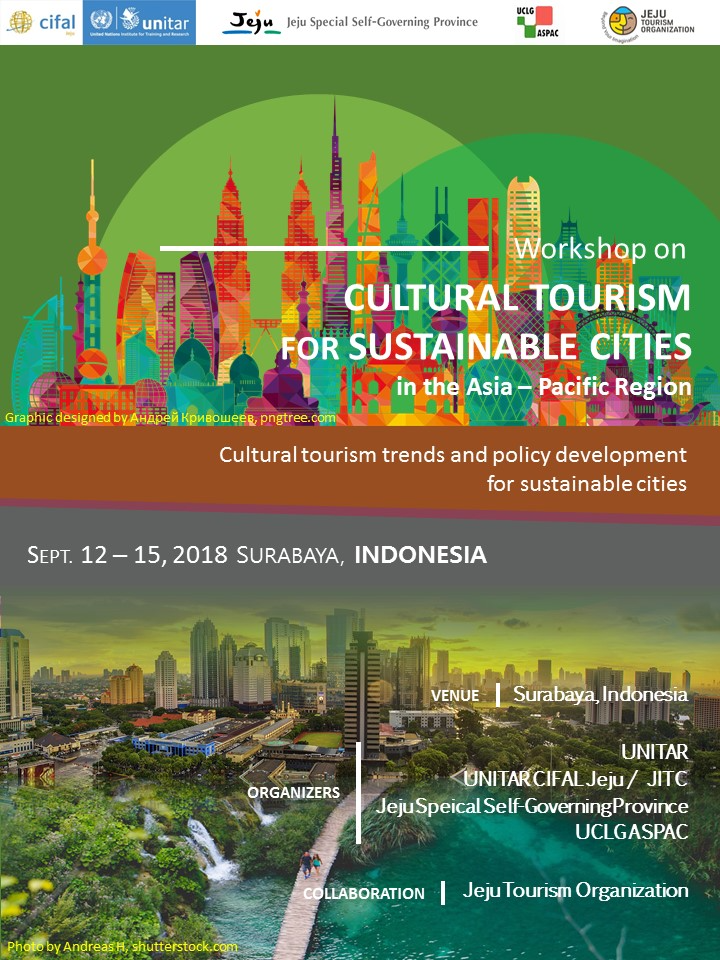
Workshop on Cultural Tourism for Sustainable Cities in the Asia-Pacific Region
Surabaya, Indonesia, September 12 ~ 15, 2018
I. Background
“Culture is key to what makes cities attractive, creative and sustainable. History shows that culture is at the heart of urban development, evidenced through cultural landmarks, heritage and traditions. Without culture, cities as vibrant life-spaces do not exist; they are merely concrete and steel constructions, prone to social degradation and fracture. It is culture that makes the difference.” (UNESCO, 2016)[1]. Culture which widely refers to values, beliefs, knowledge and wisdom[2] has become recognized as a powerful source of sustainable development. Considerations for culture in developing sustainable cities are indispensable for respecting and satisfying people before and after policy development and implementation processes.
Culture and tourism can complementarily interact with each other as tourist destinations inevitably involve the interface of their rich and diverse heritage, art, religion and other elements that represent the unique characteristics of their daily lives. With its close-knit relation of culture to our daily life, culture not only reduces barriers to economic development for local communities through tourism, but also provides easier access to cultural differences for tourists. In 2004, UNCTAD read this trend, stating “if the 49 Least Developed Countries (LDCs) are taken together, tourism is the single most important source of foreign exchange earnings.”[3]Utilizing the unique culture of a community, which is the great resource of tourism, can be a cost-effective measure of economic development with its less invested infrastructure compared to other industries.
Despite the economic benefits brought by tourism, however, many countries have been experiencing the negative consequences of reckless development, including the degradation of cultural and natural heritage, loss of cultural features and unequal distributions of economic gains. The need for well-designed plans for sustainable tourism has been highlighted to ensure the long-term economic, environmental and social benefits through tourism. Cities, in particular, which have been dramatically transformed amid global urbanization, need to recover its own characteristics, placing culture in the center of urban planning as well as tourism management, in order to achieve balanced development in the long term.
This workshop, therefore, provides a venue for participants to understand the complex relation between culture and tourism through various lectures and group activities. Best practices on cultural tourism will be presented, offering opportunities to explore well-designed tourism development cases around the world. There will be sessions to discuss good policies and practical cultural projects in line with the UN SDGs. Finally, the workshop will help local actors effectively develop relevant policies, promoting and enhancing their cultural advantages and diversification for the social, environmental and economic benefits in the long term.
II. Event objectives
The workshop aims to build capacity of participants on cultural tourism policy, whilst promoting awareness and recognition on the importance of culture and sustainable tourism development. For the capacity building, this event will;
· Provide an opportunity for the local governments and cities in the Asia-Pacific region to exchange cultural tourism policies and best practices through city-to-city cooperation.
· Promote a learning atmosphere between cities and establish a strong network which can be utilized after the workshop.
· Offer a venue for knowledge sharing and discussion and motivate participants to implement sustainable tourism policies, placing culture in the center of the policy.
III. Learning objectives
At the end of the workshop, the participants will be able to:
· Understand the cultural tourism trends and policy development in the context of 2030 Sustainable Development Agenda.
· Utilize the lessons learned from the cases of cultural tourism policy implementation in various regions.
· Have a basic understanding of cultural tourism and deepen the ideas of sustainable practices for regional/city/local development through local people’s participation.
· Share the best practices of the community/local government-driven tourism projects
· Understand the economic impacts of cultural tourism on the regional development, recognizing the importance of environmental and cultural conservation for sustainable tourism.
· Coordinate partnerships to effectively promote the benefits of cultural tourism policies with civil societies, government and local entrepreneurs.
IV. Content and structure
The training will be composed of the following sessions:
· Cultural Tourism and the UN SDGs
· Cultural Tourism as an Economic Development Tool
· Environmental Protection for Cultural Tourism
· Cultural Heritage Management and Sustainable Development
· Monitoring and Evaluating Cultural Tourism Projects
· Cultural Tourism Development: Case Studies
· Tourism Finance and Investment
· UNITAR-Developed City-Share Methodology
** Sessions are flexible to changes. **
V. Methodology
The training will be comprised of:
· Lectures and presentations by experts
· Self-assessment exercise
· Group work and discussion
· Action plan presentation
· Field visit to well-managed touristic spots
VI. Target audience
Central/local authorities and representatives from NGOs, regional and community-based organizations, academic and training institutions and other local actors, who are working in the field of tourism, cultural development and/or city planning within the Asia-Pacific region.
** Participants should have a sufficient command of both written and spoken English.
VII. Event detail
· Event type Workshop (training program)
· Date September 12 - 15, 2018
· Venue Surabaya, Indonesia
· Organizers - UNITAR
- UNITAR CIFAL Jeju/JITC
- Jeju Special Self-Governing Province
- United Cities and Local Governments Asia and Pacific
(UCLG ASPAC)
· Collaboration - Jeju Tourism Organization
· Certificate UNITAR and UNITAR CIFAL Jeju/JITC will jointly issue a certificate upon the completion of the training
** This workshop is held in parallel with the 7th UCLG ASPAC Congress.**
VIII. Requirements
Applicants are required to:
· Submit necessary documents on time, i.e., application forms etc.
· Complete and submit pre-training assignment, i.e., case study description etc.
· Actively participate in the training program.
· Be fluent in written and spoken English.
IX. Application and deadline
Send the following documents to cifaljeju.tdev@gmail.com by August 14, 2018 (Tuesday):
1. Application form | Download from http://www.cifaljeju.org/ |
2. Letter of nomination |
3. Letter of commitment |
4. Acknowledgement, waiver and release of liability |
5. Consent to collection, usage, and disclosure of personal information |
6. Case study description(in word file) |
7. Curriculum vitae (CV) | Your own format |
** Late application will not be accepted.
X. Note
· Application without the required documents will NOT be considered.· Participation is subject to approval of the application by UNITAR CIFAL Jeju/JITC. · Selected applicants will be notified individually.
XI. Assistance with travel expenses
· UNITAR CIFAL Jeju/JITC provides a LIMITED financial assistance with the airfare to Surabaya, Indonesia.
Point of departure | Airfare Assistance Limit |
Eastern Asia | Hong Kong, Macao and Taiwan | US$ 300 |
| China and Japan | US$ 450 |
Mongolia | US$ 550 |
South-Eastern Asia | Malaysia, Singapore | US$ 100 |
| Brunei Darussalam | US$ 200 |
| Philippines, Thailand, Vietnam, Cambodia, Myanmar | US$ 300 |
Lao PDR | US$ 450 |
Southern Asia | Bangladesh, Bhutan, India, Maldives, Nepal and Sri Lanka | US$ 550 |
Afghanistan, Pakistan | US$ 800 |
Pacific Islands | Kiribati, Papua New Guinea, Samoa, Tuvalu and Vanuatu | US$ 1,200 |
* Other points of departure – please contact UNITAR CIFAL Jeju/JITC |
· Local expenses (transportation, accommodation and meals) during the workshop will be covered by UNITAR CIFAL Jeju/JITC except for arrival and departure days.
· All other expenses (local transportation in their country, visa fee) should be covered by the participants.
[2] UCLG (2015), Culture 21: Agenda 21 for Culture, Committee on Culture UCLG, Barcelona
[3] UNCTAD (2004), World Investment Report 2004. The Shift Towards Services. United Nations Conference on Trade and Development, Geneva.


Workshop on Cultural Tourism for Sustainable Cities in the Asia-Pacific Region
Surabaya, Indonesia, September 12 ~ 15, 2018
I. Background
“Culture is key to what makes cities attractive, creative and sustainable. History shows that culture is at the heart of urban development, evidenced through cultural landmarks, heritage and traditions. Without culture, cities as vibrant life-spaces do not exist; they are merely concrete and steel constructions, prone to social degradation and fracture. It is culture that makes the difference.” (UNESCO, 2016)[1]. Culture which widely refers to values, beliefs, knowledge and wisdom[2] has become recognized as a powerful source of sustainable development. Considerations for culture in developing sustainable cities are indispensable for respecting and satisfying people before and after policy development and implementation processes.
Culture and tourism can complementarily interact with each other as tourist destinations inevitably involve the interface of their rich and diverse heritage, art, religion and other elements that represent the unique characteristics of their daily lives. With its close-knit relation of culture to our daily life, culture not only reduces barriers to economic development for local communities through tourism, but also provides easier access to cultural differences for tourists. In 2004, UNCTAD read this trend, stating “if the 49 Least Developed Countries (LDCs) are taken together, tourism is the single most important source of foreign exchange earnings.”[3]Utilizing the unique culture of a community, which is the great resource of tourism, can be a cost-effective measure of economic development with its less invested infrastructure compared to other industries.
Despite the economic benefits brought by tourism, however, many countries have been experiencing the negative consequences of reckless development, including the degradation of cultural and natural heritage, loss of cultural features and unequal distributions of economic gains. The need for well-designed plans for sustainable tourism has been highlighted to ensure the long-term economic, environmental and social benefits through tourism. Cities, in particular, which have been dramatically transformed amid global urbanization, need to recover its own characteristics, placing culture in the center of urban planning as well as tourism management, in order to achieve balanced development in the long term.
This workshop, therefore, provides a venue for participants to understand the complex relation between culture and tourism through various lectures and group activities. Best practices on cultural tourism will be presented, offering opportunities to explore well-designed tourism development cases around the world. There will be sessions to discuss good policies and practical cultural projects in line with the UN SDGs. Finally, the workshop will help local actors effectively develop relevant policies, promoting and enhancing their cultural advantages and diversification for the social, environmental and economic benefits in the long term.
II. Event objectives
The workshop aims to build capacity of participants on cultural tourism policy, whilst promoting awareness and recognition on the importance of culture and sustainable tourism development. For the capacity building, this event will;
· Provide an opportunity for the local governments and cities in the Asia-Pacific region to exchange cultural tourism policies and best practices through city-to-city cooperation.
· Promote a learning atmosphere between cities and establish a strong network which can be utilized after the workshop.
· Offer a venue for knowledge sharing and discussion and motivate participants to implement sustainable tourism policies, placing culture in the center of the policy.
III. Learning objectives
At the end of the workshop, the participants will be able to:
· Understand the cultural tourism trends and policy development in the context of 2030 Sustainable Development Agenda.
· Utilize the lessons learned from the cases of cultural tourism policy implementation in various regions.
· Have a basic understanding of cultural tourism and deepen the ideas of sustainable practices for regional/city/local development through local people’s participation.
· Share the best practices of the community/local government-driven tourism projects
· Understand the economic impacts of cultural tourism on the regional development, recognizing the importance of environmental and cultural conservation for sustainable tourism.
· Coordinate partnerships to effectively promote the benefits of cultural tourism policies with civil societies, government and local entrepreneurs.
IV. Content and structure
The training will be composed of the following sessions:
· Cultural Tourism and the UN SDGs
· Cultural Tourism as an Economic Development Tool
· Environmental Protection for Cultural Tourism
· Cultural Heritage Management and Sustainable Development
· Monitoring and Evaluating Cultural Tourism Projects
· Cultural Tourism Development: Case Studies
· Tourism Finance and Investment
· UNITAR-Developed City-Share Methodology
** Sessions are flexible to changes. **
V. Methodology
The training will be comprised of:
· Lectures and presentations by experts
· Self-assessment exercise
· Group work and discussion
· Action plan presentation
· Field visit to well-managed touristic spots
VI. Target audience
Central/local authorities and representatives from NGOs, regional and community-based organizations, academic and training institutions and other local actors, who are working in the field of tourism, cultural development and/or city planning within the Asia-Pacific region.
** Participants should have a sufficient command of both written and spoken English.
VII. Event detail
· Event type Workshop (training program)
· Date September 12 - 15, 2018
· Venue Surabaya, Indonesia
· Organizers - UNITAR
- UNITAR CIFAL Jeju/JITC
- Jeju Special Self-Governing Province
- United Cities and Local Governments Asia and Pacific
(UCLG ASPAC)
· Collaboration - Jeju Tourism Organization
· Certificate UNITAR and UNITAR CIFAL Jeju/JITC will jointly issue a certificate upon the completion of the training
** This workshop is held in parallel with the 7th UCLG ASPAC Congress.**
VIII. Requirements
Applicants are required to:
· Submit necessary documents on time, i.e., application forms etc.
· Complete and submit pre-training assignment, i.e., case study description etc.
· Actively participate in the training program.
· Be fluent in written and spoken English.
IX. Application and deadline
Send the following documents to cifaljeju.tdev@gmail.com by August 14, 2018 (Tuesday):
1. Application form
Download from http://www.cifaljeju.org/
2. Letter of nomination
3. Letter of commitment
4. Acknowledgement, waiver and release of liability
5. Consent to collection, usage, and disclosure of personal information
6. Case study description(in word file)
7. Curriculum vitae (CV)
Your own format
** Late application will not be accepted.
X. Note
· Application without the required documents will NOT be considered.· Participation is subject to approval of the application by UNITAR CIFAL Jeju/JITC.
· Selected applicants will be notified individually.
XI. Assistance with travel expenses
· UNITAR CIFAL Jeju/JITC provides a LIMITED financial assistance with the airfare to Surabaya, Indonesia.
Point of departure
Airfare Assistance Limit
Eastern Asia
Hong Kong, Macao and Taiwan
US$ 300
Mongolia
US$ 550
South-Eastern Asia
Malaysia, Singapore
US$ 100
Lao PDR
US$ 450
Southern Asia
Bangladesh, Bhutan, India, Maldives, Nepal and Sri Lanka
US$ 550
Afghanistan, Pakistan
US$ 800
Pacific Islands
Kiribati, Papua New Guinea, Samoa, Tuvalu and Vanuatu
US$ 1,200
* Other points of departure – please contact UNITAR CIFAL Jeju/JITC
· Local expenses (transportation, accommodation and meals) during the workshop will be covered by UNITAR CIFAL Jeju/JITC except for arrival and departure days.
· All other expenses (local transportation in their country, visa fee) should be covered by the participants.
[1] UNESCO (2016) Global Report on Culture for Sustainable Urban Development. Available at: http://unesdoc.unesco.org/images/0024/002459/245999e.pdf [Accessed on 24 Feb, 2017]
[2] UCLG (2015), Culture 21: Agenda 21 for Culture, Committee on Culture UCLG, Barcelona
[3] UNCTAD (2004), World Investment Report 2004. The Shift Towards Services. United Nations Conference on Trade and Development, Geneva.