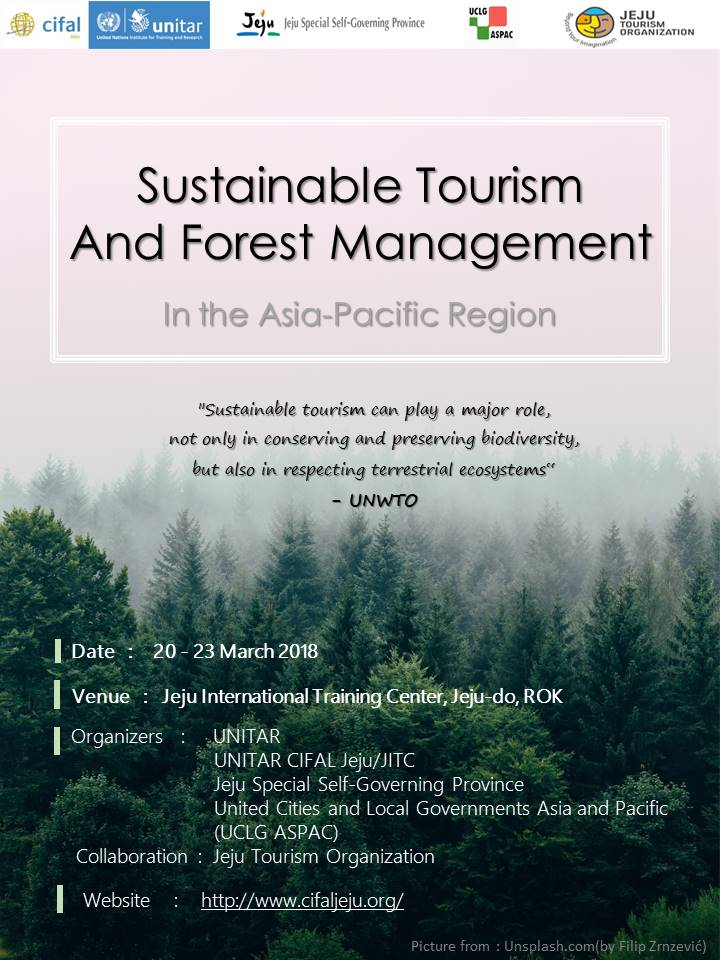
Sustainable Tourism and Forest Management in the Asia-Pacific Region
Jeju-do, Republic of Korea, March 20~23, 2018
I. Background
Tourism is certainly the largest and fastest-growing industry in the world. Today, tourism accounts for 10 per cent of the global GDP, creating 1 in every 11 jobs in the world. Every year, millions of tourists flock to various tourist attractions such as historical sites, museums and coastlines, bringing income and jobs to local economies. In fact, international tourist arrivals grew by 4.6 per cent in 2015, recording 1,184 million. The UN World Tourism Organisation (UNWTO) forecasts that this number will reach 1.8 billion by 2030.[1] Recognizing the importance of tourism, the United Nations 70th General Assembly has designated 2017 as the International Year of Sustainable Tourism for Development.
Despite the economic and social benefits brought by tourism, however, many countries have been experiencing negative consequences from the increased number of tourists and excessive development. In particular, unplanned land development has resulted in losing a vast area of forests. Forestr serves as one of the major sources of income through tourism and the provision of natural resources in many countries, while playing a critical role in conserving of biodiversity and mitigating climate change. In this regard, forest loss can immensely threaten people’s livelihoods, and plants and animal species.
According to the recent studies[2], 45 per cent of the Earth’s forests have been cleared, which has raised concerns over the mass scale of development and forest loss. Now, the dominant agenda should move its focus from ‘how much developed’ to ‘how well developed’ to ensure long-term economic, environmental and social benefits. Therefore, well designed planning for forest management and sustainable tourism plays a significant role in sustainable development.
This workshop provides a venue for participants to understand the relationship between sustainable forest management and tourism through various lectures and group activities. Best practices on forest management and tourism will be presented, offering opportunities to explore well-designed tourism development cases around the world. There will be sessions to discuss good policies and practical sustainable tourism projects in line with the UN SDGs. Finally, the workshop will help local actors effectively develop relevant policies, promoting and enhancing their geographical advantages for the social, environmental and economic benefits in the long term.
II. Event objectives
The workshop aims to build capacity of participants on forest management, whilst promoting awareness and recognition on the importance of forest management in sustainable tourism. For the capacity building, this event will;
· Provide an opportunity for the local governments and cities in the Asia-Pacific region to exchange forest management policies and best practices relevant to sustainable tourism through city-to-city cooperation;
· Promote a learning atmosphere between cities and establish a strong network which can be utilized after the workshop;
· Offer a venue for knowledge sharing and discussion and motivate participants to implement forest managment policies, with particular focues on sustainable tourism.
III. Learning objectives
At the end of the workshop, the participants will be able to:
· Understand the sustainable tourism trends and forest managment in the context of 2030 Sustainable Development Agenda;
· Utilize the lessons learned from the good cases of forest management policy implementation;
· Have a basic understanding of forest management and sustainable tourism and deepen the ideas of sustainable practices for regional/local development through local people’s participation;
· Share the best practices of the community/local government-driven tourism projects;
· Understand the economic impacts of conservation on the regional development, recognizing the importance of forest management;
· Coordinate partnerships to effectively promote the benefits of forest management policies with civil societies, government and local entrepreneurs.
IV. Content and structure
The training will be composed of the following sessions:
[Session 1] The Global Trends of Sustainable Tourism and the UN SDGs
[Session 2] Basic Understanding of Forest Management
[Session 3] Ecotourism for Sustainable Forest Management
[Session 4] Forest Management for Economic and Environmental Benefits : PESs
[Session 5] Community Benefit-sharing Mechanisms and Social Safeguards in Forest Mangement
[Session 6] Sustainable Tourism Marketing Strategies for Tourist Destinations
[Session 7-1] Forestry Management I : Restoring forests
[Session 7-2] Forestry Management II: Forest Biodiversity Conservation
[Session 8] Forest Management Planning for Poverty Alleviation: a Case Study of East Tmor
[Session 9] Sustainable Tourism Development: a Case Study of Jeju Olle
[Session 10] UNITAR-Developed City-Share Methodology
** Sessions are flexible to changes. **
V. Methodology
The training will be comprised of:
· Lectures and presentations by experts
· Self-assessment exercise
· Group work and discussion
· Action plan presentation
· Field visit to well-managed touristic spots
VI. Target audience
Central/local authorities and representatives from NGOs, regional and community-based organizations, academic and training institutions and other local actors, who are working in the field of sustainable tourism and forest management within the Asia-Pacific region.
** Participants should have a sufficient command of both written and spoken English.
VII. Event detail
· Event type Workshop (training program)
· Date 20 - 23 March 2018
· Venue Jeju International Training Center, Jeju-do, ROK
· Organizers
- UNITAR
- UNITAR CIFAL Jeju/JITC
- Jeju Special Self-Governing Province
- United Cities and Local Governments Asia and Pacific (UCLG ASPAC)
· Collaboration Jeju Tourism Organization
· Certificate UNITAR and UNITAR CIFAL Jeju/JITC will jointly issue a certificate upon the completion of the training
VIII. Requirements
Applicants are required to:
· Submit necessary documents on time, i.e., application forms etc.
· Complete and submit pre-training assignment, i.e., case study description etc.
· Actively participate in the training program.
· Be fluent in written and spoken English.
IX. Application and deadline
Send the following documents to cifaljeju.tdev@gmail.com by 18 Feb 2018 (Sun):
1. Application form
2. Letter of nomination
3. Letter of commitment
4. Acknowledgement, waiver and release of liability
5. Consent to collection, usage, and disclosure of personal information
6. Case study description(in word file) |
Download from http://www.cifaljeju.org/ |
| 7. Curriculum vitae (CV) | Your own format |
** Late application will not be accepted.
X. Note
- Application without the required documents will NOT be considered.
- Participation is subject to approval of the application by UNITAR CIFAL Jeju/JITC.
- Selected applicants will be notified individually.
XI. Assistance with travel expenses
- UNITAR CIFAL Jeju/JITC provides a LIMITED financial assistance with the airfare to Jeju-do, Republic of Korea.
Point of departure
| Airfare Assistance Limit |
Eastern Asia
| China, Hong Kong, Macao, Japan and Taiwan
| US$ 300
|
Mongolia
| US$ 550 |
| South-Eastern Asia | Brunei Darussalam, Indonesia, Malaysia, Philippines, Singapore, Thailand, and Vietnam
| US$ 450 |
| Cambodia, Lao PDR and Myanmar | US$ 650 |
| Southern Asia | Afghanistan, Bhutan, India, Maldives and Pakistan | US$ 800 |
Sri Lanka
| US$ 800
|
Bangladesh
| US$ 850
|
| Nepal | US$ 950
|
| Pacific Islands | Kiribati, Papua New Guinea, Samoa, Tuvalu and Vanuatu
| US$ 1,200
|
| * Other points of departure – please contact UNITAR CIFAL Jeju/JITC |
- Local expenses (transportation, accommodation and meals) during the workshop will be covered by UNITAR CIFAL Jeju/JITC except for arrival and departure days.
- All other expenses (local transportation in their country, visa fee) should be covered by the participants.
[1] UNWTO.
[2] https://www.cbd.int/doc/publications/development/brochure-tourism-en.pdf


Sustainable Tourism and Forest Management in the Asia-Pacific Region
Jeju-do, Republic of Korea, March 20~23, 2018
I. Background
Tourism is certainly the largest and fastest-growing industry in the world. Today, tourism accounts for 10 per cent of the global GDP, creating 1 in every 11 jobs in the world. Every year, millions of tourists flock to various tourist attractions such as historical sites, museums and coastlines, bringing income and jobs to local economies. In fact, international tourist arrivals grew by 4.6 per cent in 2015, recording 1,184 million. The UN World Tourism Organisation (UNWTO) forecasts that this number will reach 1.8 billion by 2030.[1] Recognizing the importance of tourism, the United Nations 70th General Assembly has designated 2017 as the International Year of Sustainable Tourism for Development.
Despite the economic and social benefits brought by tourism, however, many countries have been experiencing negative consequences from the increased number of tourists and excessive development. In particular, unplanned land development has resulted in losing a vast area of forests. Forestr serves as one of the major sources of income through tourism and the provision of natural resources in many countries, while playing a critical role in conserving of biodiversity and mitigating climate change. In this regard, forest loss can immensely threaten people’s livelihoods, and plants and animal species.
According to the recent studies[2], 45 per cent of the Earth’s forests have been cleared, which has raised concerns over the mass scale of development and forest loss. Now, the dominant agenda should move its focus from ‘how much developed’ to ‘how well developed’ to ensure long-term economic, environmental and social benefits. Therefore, well designed planning for forest management and sustainable tourism plays a significant role in sustainable development.
This workshop provides a venue for participants to understand the relationship between sustainable forest management and tourism through various lectures and group activities. Best practices on forest management and tourism will be presented, offering opportunities to explore well-designed tourism development cases around the world. There will be sessions to discuss good policies and practical sustainable tourism projects in line with the UN SDGs. Finally, the workshop will help local actors effectively develop relevant policies, promoting and enhancing their geographical advantages for the social, environmental and economic benefits in the long term.
II. Event objectives
The workshop aims to build capacity of participants on forest management, whilst promoting awareness and recognition on the importance of forest management in sustainable tourism. For the capacity building, this event will;
· Provide an opportunity for the local governments and cities in the Asia-Pacific region to exchange forest management policies and best practices relevant to sustainable tourism through city-to-city cooperation;
· Promote a learning atmosphere between cities and establish a strong network which can be utilized after the workshop;
· Offer a venue for knowledge sharing and discussion and motivate participants to implement forest managment policies, with particular focues on sustainable tourism.
III. Learning objectives
At the end of the workshop, the participants will be able to:
· Understand the sustainable tourism trends and forest managment in the context of 2030 Sustainable Development Agenda;
· Utilize the lessons learned from the good cases of forest management policy implementation;
· Have a basic understanding of forest management and sustainable tourism and deepen the ideas of sustainable practices for regional/local development through local people’s participation;
· Share the best practices of the community/local government-driven tourism projects;
· Understand the economic impacts of conservation on the regional development, recognizing the importance of forest management;
· Coordinate partnerships to effectively promote the benefits of forest management policies with civil societies, government and local entrepreneurs.
IV. Content and structure
The training will be composed of the following sessions:
[Session 1] The Global Trends of Sustainable Tourism and the UN SDGs
[Session 2] Basic Understanding of Forest Management
[Session 3] Ecotourism for Sustainable Forest Management
[Session 4] Forest Management for Economic and Environmental Benefits : PESs
[Session 5] Community Benefit-sharing Mechanisms and Social Safeguards in Forest Mangement
[Session 6] Sustainable Tourism Marketing Strategies for Tourist Destinations
[Session 7-1] Forestry Management I : Restoring forests
[Session 7-2] Forestry Management II: Forest Biodiversity Conservation
[Session 8] Forest Management Planning for Poverty Alleviation: a Case Study of East Tmor
[Session 9] Sustainable Tourism Development: a Case Study of Jeju Olle
[Session 10] UNITAR-Developed City-Share Methodology
** Sessions are flexible to changes. **
V. Methodology
The training will be comprised of:
· Lectures and presentations by experts
· Self-assessment exercise
· Group work and discussion
· Action plan presentation
· Field visit to well-managed touristic spots
VI. Target audience
Central/local authorities and representatives from NGOs, regional and community-based organizations, academic and training institutions and other local actors, who are working in the field of sustainable tourism and forest management within the Asia-Pacific region.
** Participants should have a sufficient command of both written and spoken English.
VII. Event detail
· Event type Workshop (training program)
· Date 20 - 23 March 2018
· Venue Jeju International Training Center, Jeju-do, ROK
· Organizers
· Collaboration Jeju Tourism Organization
· Certificate UNITAR and UNITAR CIFAL Jeju/JITC will jointly issue a certificate upon the completion of the training
VIII. Requirements
Applicants are required to:
· Submit necessary documents on time, i.e., application forms etc.
· Complete and submit pre-training assignment, i.e., case study description etc.
· Actively participate in the training program.
· Be fluent in written and spoken English.
IX. Application and deadline
Send the following documents to cifaljeju.tdev@gmail.com by 18 Feb 2018 (Sun):
2. Letter of nomination
3. Letter of commitment
4. Acknowledgement, waiver and release of liability
5. Consent to collection, usage, and disclosure of personal information
6. Case study description(in word file)
Download from http://www.cifaljeju.org/
** Late application will not be accepted.
X. Note
XI. Assistance with travel expenses
[1] UNWTO.
[2] https://www.cbd.int/doc/publications/development/brochure-tourism-en.pdf