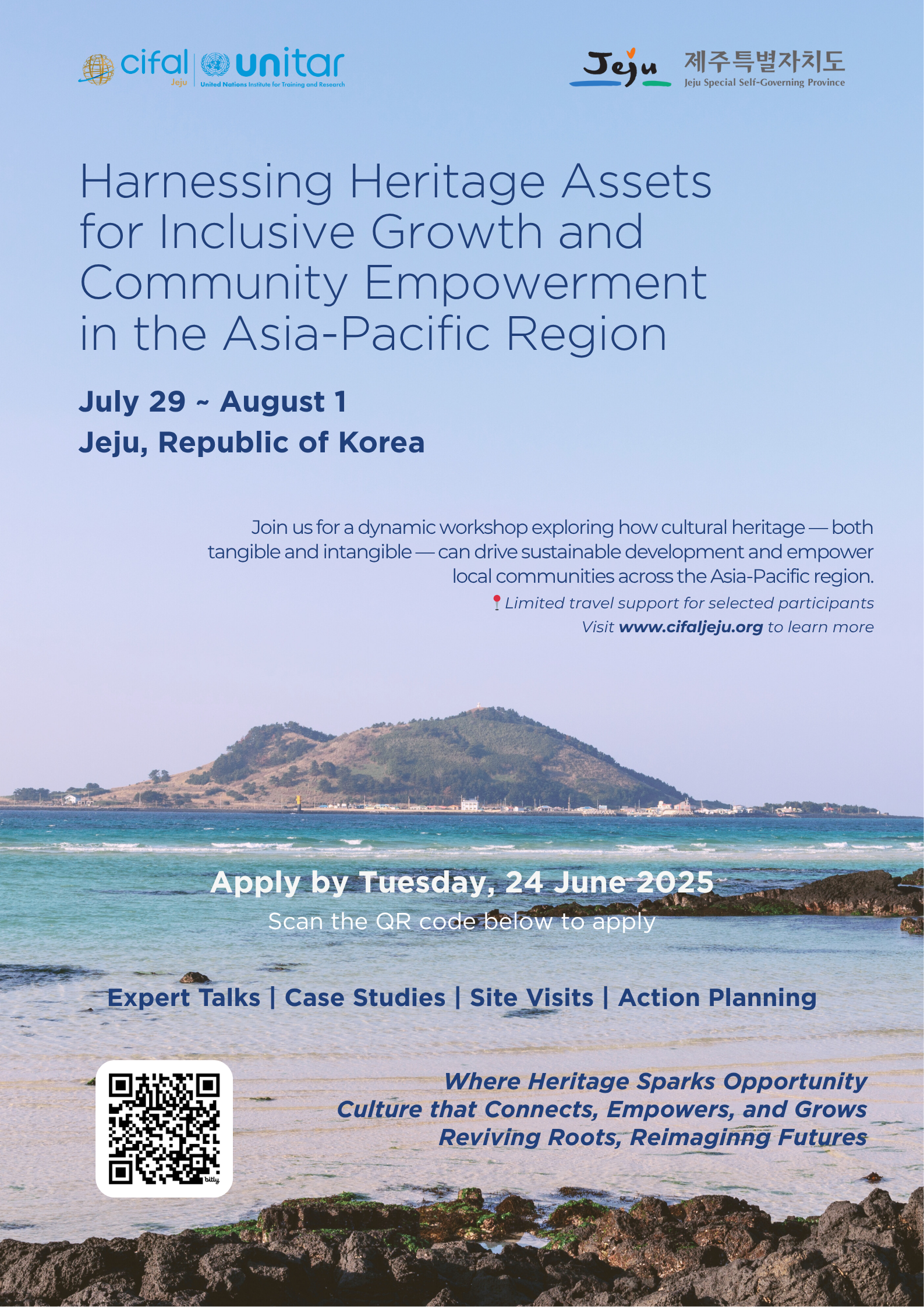
Workshop on
Harnessing Heritage Assets for Inclusive Growth and Community Empowerment in the Asia-Pacific Region
July 29 ~ August 1
Jeju, Republic of Korea
Organized by United Nations Institute for Training and Research (UNITAR) CIFAL Jeju
in cooperation with UNESCO Regional Office for East Asia
Background
Peripheral and rural areas across the Asia-Pacific region are often endowed with a wealth of tangible and intangible cultural heritage. These include centuries-old temples and vernacular architecture, sacred landscapes, oral traditions, crafts, music, foodways, and knowledge systems rooted in the lived experiences of communities. This diversity of cultural expression forms the backbone of local identity and resilience.
Despite this cultural richness, peripheral communities frequently find themselves excluded from mainstream development agendas. They often face significant challenges such as youth outmigration, aging populations, limited infrastructure, underfunded institutions, and insufficient recognition in national cultural policies. Meanwhile, their unique heritage – ifleft undervalued or unmanaged – canbecome vulnerable to erosion, commodification, or even erasure.
Harnessing heritage as a foundation for inclusive growth and empowerment represents a transformative opportunity. When placed at the center of community-led development strategies, both tangible and intangible heritage can offer sustainable livelihoods, revive community pride, foster intergenerational knowledge transfer, and attract responsible tourism. These pathways are especially critical in the context of global challenges such as climate change, natural disasters, cultural homogenization, and post-pandemic recovery. Heritage, in this sense, is not a luxury or a nostalgic burden – itis a dynamic asset for development, healing, and innovation.
International frameworks such as the 2030 Agenda for Sustainable Development (particularly SDG 11), the UNESCO Convention for the Safeguarding of the Intangible Cultural Heritage, the New Urban Agenda, and the Culture|2030 Indicators have all emphasized the importance of culture in driving sustainable, inclusive, and locally relevant development. However, there remains a persistent gap between high-level declarations and localized capacity to design and implement heritage-based solutions – especiallyin underserved, remote, or structurally disadvantaged areas.
This workshop seeks to bridge that gap. It aims to equip local actors – governmentrepresentatives, cultural practitioners, and civil society leaders – withactionable knowledge, peer learning, and collaborative tools to transform heritage into a driver of equitable development and community empowerment. Through real-world case studies, immersive site visits, and structured action planning, participants will co-create strategies rooted in their own contexts while building a regional network for future collaboration.
Event Objective
This workshop aims to:
- Strengthen the capacities of local actors to leverage heritage assets for inclusive and sustainable development;
- Showcase practical, real-world models of community-based cultural heritage management and planning;
- Facilitate peer-to-peer knowledge exchange among local communities across the Asia-Pacific region;
- Support participants in developing localized action plans for heritage-driven empowerment and growth.
Expected outcomes
By the end of the workshop, participants will be able to:
· Analyze the development potential of tangible and intangible heritage in their own communities;
· Identify and apply inclusive and participatory governance approaches to heritage planning;
· Understand practical tools (e.g., digital, financial, regulatory) that support community-driven heritage initiatives;
· Learn from context-specific case studies that showcase how heritage assets can be leveraged for inclusive growth and community empowerment;
· Draft an implementation-ready local action plan or pilot project proposal suited to their own context.
Target audience
This workshop is designed for:
- Representatives from UCLG ASPAC Culture Committee member cities and relevant institutions;
- Local government officers and policymakers from smaller cities and rural (or peripheral) areas;
- Representatives of civil society, grassroots organizations, and cultural institutions;
- Cultural heritage professionals, planners, and community developers;
Methodology
The workshop will be delivered using a blended capacity-building approach, combining:
- Expert Lectures grounded in real-world cases across the Asia-Pacific region;
- Participants’ Case Study Sharing to reflect field realities;
- Site Visits to heritage-based projects, including both tangible and intangible elements;
- Group Discussions and problem-analysis exercises using participatory tools (e.g., SWOT, Problem/Objective Trees);
- Action Planning Sessions for each participant to design a tailored heritage-based initiative or pilot strategy.
Workshop Structure (Overview)
Day | Theme | Activities |
Day 1 | Setting the Scene – Heritageand Inclusive Growth | Opening Ceremony, Expert Lectures, Group Discussion |
Day 2 | Peer Learning & Field Immersion | Participants’ Case Sharing, Expert Lecture, Site Visit I |
Day 3 | Innovation, Financial Models, and Field Immersion | Expert Lectures, Group Discussion, Site Visit II |
Day 4 | From Knowledge to Action | Action Planning, Final Sharing, Closing Ceremony |
Certificate
UNITAR and UNITAR CIFAL Jeju/JITC will jointly issue a certificate upon the completion of the training.
Application and Deadline
Please upload the following documents via the link below by Tuesday, 24 June 2025.
- - https://bit.ly/4js7uYq
- - Late submissions will NO T be accepted.
- - Incomplete applications (i.e., missing required documents) will NO T be considered.
- - How clearly and substantively you answer the questions in the application form, along with the quality of your case study description, will be key criteria in the selection process.
- - Only those selected will be contacted individually via email.
1. Application form | Download the files from the relevant post on http://www.cifaljeju.org/ |
2. Letter of nomination (formatted by your organization) |
3. Letter of commitment |
4. Acknowledgement, waiver, and release of liability |
5. Consent to collection, usage, and disclosure of personal information |
6. Case study description (in word file) |
7. Curriculum Vitae (CV) | Your own format |
Contact Information
For more information, please contact:
Email: cifaljeju.jitc.1@gmail.com
Website: http://www.cifaljeju.org










Workshop on
Harnessing Heritage Assets for Inclusive Growth and Community Empowerment in the Asia-Pacific Region
July 29 ~ August 1
Jeju, Republic of Korea
Organized by United Nations Institute for Training and Research (UNITAR) CIFAL Jeju
in cooperation with UNESCO Regional Office for East Asia
Background
Peripheral and rural areas across the Asia-Pacific region are often endowed with a wealth of tangible and intangible cultural heritage. These include centuries-old temples and vernacular architecture, sacred landscapes, oral traditions, crafts, music, foodways, and knowledge systems rooted in the lived experiences of communities. This diversity of cultural expression forms the backbone of local identity and resilience.
Despite this cultural richness, peripheral communities frequently find themselves excluded from mainstream development agendas. They often face significant challenges such as youth outmigration, aging populations, limited infrastructure, underfunded institutions, and insufficient recognition in national cultural policies. Meanwhile, their unique heritage – ifleft undervalued or unmanaged – canbecome vulnerable to erosion, commodification, or even erasure.
Harnessing heritage as a foundation for inclusive growth and empowerment represents a transformative opportunity. When placed at the center of community-led development strategies, both tangible and intangible heritage can offer sustainable livelihoods, revive community pride, foster intergenerational knowledge transfer, and attract responsible tourism. These pathways are especially critical in the context of global challenges such as climate change, natural disasters, cultural homogenization, and post-pandemic recovery. Heritage, in this sense, is not a luxury or a nostalgic burden – itis a dynamic asset for development, healing, and innovation.
International frameworks such as the 2030 Agenda for Sustainable Development (particularly SDG 11), the UNESCO Convention for the Safeguarding of the Intangible Cultural Heritage, the New Urban Agenda, and the Culture|2030 Indicators have all emphasized the importance of culture in driving sustainable, inclusive, and locally relevant development. However, there remains a persistent gap between high-level declarations and localized capacity to design and implement heritage-based solutions – especiallyin underserved, remote, or structurally disadvantaged areas.
This workshop seeks to bridge that gap. It aims to equip local actors – governmentrepresentatives, cultural practitioners, and civil society leaders – withactionable knowledge, peer learning, and collaborative tools to transform heritage into a driver of equitable development and community empowerment. Through real-world case studies, immersive site visits, and structured action planning, participants will co-create strategies rooted in their own contexts while building a regional network for future collaboration.
Event Objective
This workshop aims to:
Expected outcomes
By the end of the workshop, participants will be able to:
· Analyze the development potential of tangible and intangible heritage in their own communities;
· Identify and apply inclusive and participatory governance approaches to heritage planning;
· Understand practical tools (e.g., digital, financial, regulatory) that support community-driven heritage initiatives;
· Learn from context-specific case studies that showcase how heritage assets can be leveraged for inclusive growth and community empowerment;
· Draft an implementation-ready local action plan or pilot project proposal suited to their own context.
Target audience
This workshop is designed for:
Methodology
The workshop will be delivered using a blended capacity-building approach, combining:
Workshop Structure (Overview)
Day
Theme
Activities
Day 1
Setting the Scene – Heritageand Inclusive Growth
Opening Ceremony, Expert Lectures, Group Discussion
Day 2
Peer Learning & Field Immersion
Participants’ Case Sharing, Expert Lecture, Site Visit I
Day 3
Innovation, Financial Models, and Field Immersion
Expert Lectures, Group Discussion, Site Visit II
Day 4
From Knowledge to Action
Action Planning, Final Sharing, Closing Ceremony
Certificate
UNITAR and UNITAR CIFAL Jeju/JITC will jointly issue a certificate upon the completion of the training.
Application and Deadline
Please upload the following documents via the link below by Tuesday, 24 June 2025.
1. Application form
Download the files from the relevant post on http://www.cifaljeju.org/
2. Letter of nomination (formatted by your organization)
3. Letter of commitment
4. Acknowledgement, waiver, and release of liability
5. Consent to collection, usage, and disclosure of personal information
6. Case study description (in word file)
7. Curriculum Vitae (CV)
Your own format
Contact Information
For more information, please contact:
Email: cifaljeju.jitc.1@gmail.com
Website: http://www.cifaljeju.org