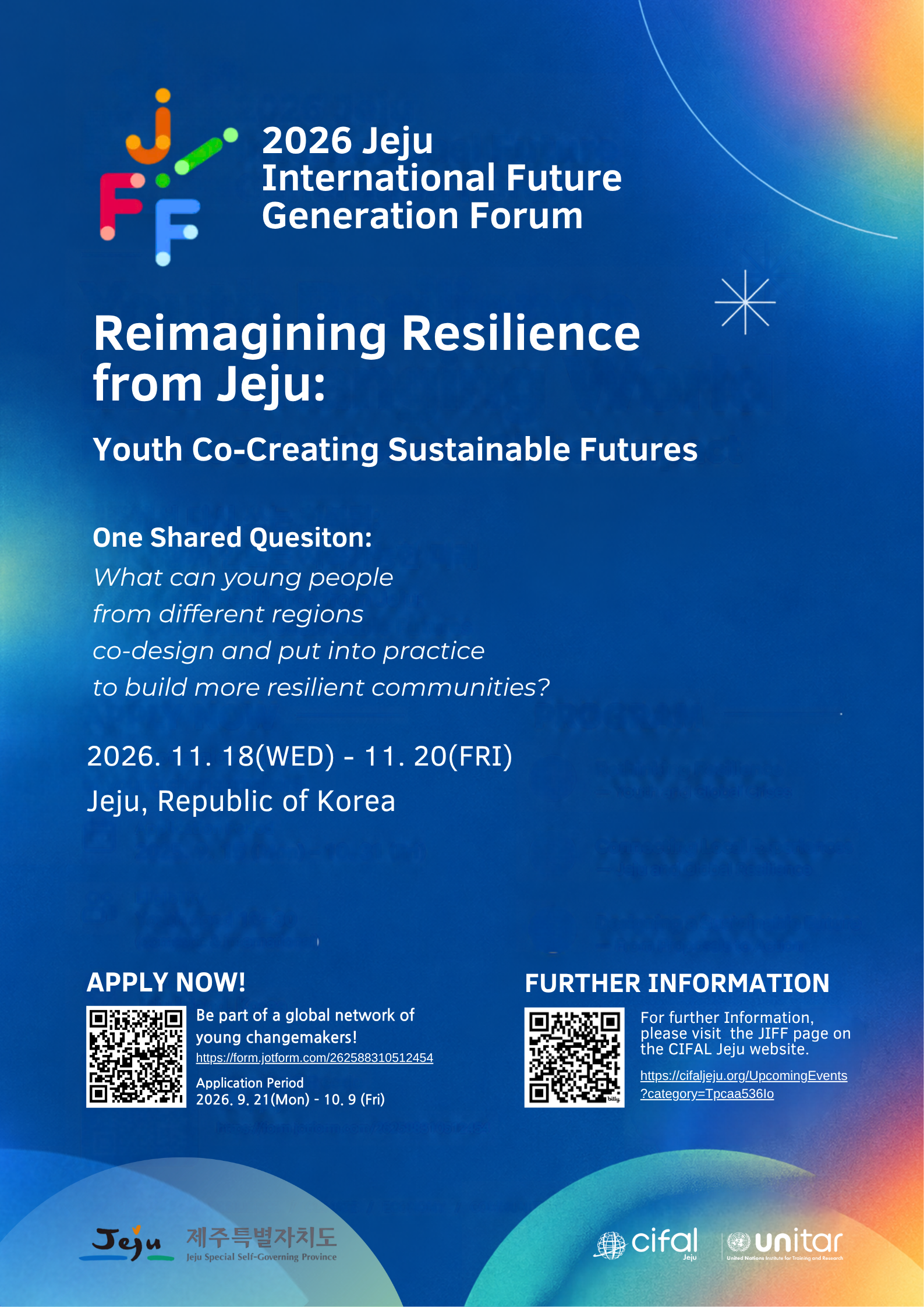
2026 Jeju International Future Generation Forum
Reimagining Resilience from Jeju – Youth Co-Creating Sustainable Futures
Date: 18–20 November 2026
Venue: Jeju island, Republic of Korea
Organized by: UNITAR CIFAL Jeju, Jeju Special Self-Governing Province
Background
Young people and local communities are increasingly affected by interconnected challenges, including climate change, economic uncertainty, conflict and growing digital divides amid rapid technological change. Although their impacts differ across regions, these challenges shape livelihoods, environmental conditions, access to information and opportunities, and prospects for the future. As their causes and consequences extend across sectors and borders, effective responses require collaboration and learning across different contexts.
In this context, resilience extends beyond recovery after a crisis. It also involves the capacity to anticipate and adapt to change, reduce exclusion, protect livelihoods and the environment, sustain social cohesion, and support peaceful and inclusive cooperation. Building resilient communities therefore requires an integrated approach that connects social, economic, environmental, technological and peace-related dimensions.
The Jeju International Future Generation Forum(JIFF) brings together young people from Korea and other countries to connect global challenges with the realities of their own communities. Guided by the Sustainable Development Goals, participants share experiences, compare how similar challenges unfold across regions, and identify lessons that may be adapted or tested in their respective contexts. Young people participate as active contributors who help frame the issues and co-design possible responses.
From 2026 onward, JIFF will adopt Youth Co-Creating Sustainable Futures as its overarching direction and examine a different core issue each year. Following the Forum’s 2025 focus on digital transformation, the 2026 programme will explore resilience as its central theme. This lens will enable participants to consider how communities respond to interconnected challenges and what choices, relationships and local capacities support longer-term adaptation and change.
Jeju provides a relevant setting for this inquiry through its ecological context, community traditions and local regeneration experiences. These experiences will serve as starting points for critical learning and comparison rather than as ready-made models for other regions. Participants will examine the conditions that enabled particular responses, the constraints and trade-offs involved, the roles of different actors, and the relevance of these lessons to their own local contexts.
Together, these considerations lead to the Forum’s core question:
What can young people from different regions co-design and put into practice to build more resilient communities in the face of interconnected crises and rapid change?
Expert input and field learning will provide a shared basis for exploring this question. Participants will compare perspectives and interests, identify key issues and stakeholders, and develop proposals and practical action plans through small-group discussion and collaborative work.
The resulting proposals, follow-up experiences and unresolved questions will be documented and used to inform future editions of JIFF. This process will allow the Forum to build a continuing cycle of youth dialogue, local experimentation and reflection, with lessons from each year carried forward into the next.
Purpose and Objectives
The Forum aims to strengthen JIFF as a continuing platform where young people learn across contexts and develop practical responses to shared challenges.
Build a shared understanding of resilience across social, economic, environmental, technological and peace-related dimensions.
Enable participants to identify and frame challenges they have experienced or observed in their own communities.
Compare Jeju-based cases with participants' local experiences and examine the conditions, constraints, actors and contextual differences that shape resilience.
Support youth-led co-design of proposals and practical action plans that can be tested or adapted after the Forum.
Carry forward participant outputs, follow-up experiences and unresolved questions into future JIFF programme design.
Participants
The Forum will bring together up to 50 young people, including participants from Jeju, its sister and friendship cities, other countries, and international students studying in the Republic of Korea.
Participant Support
Round-trip airfare will be provided, together with three nights’ accommodation during the Forum (check-in on 17 November and check-out on 20 November 2026) and meals during the official programme.
Programme Approach
The three-day programme follows a connected learning process. Each stage contributes directly to the next, moving from shared understanding to practical action.
Stage | Focus |
Understand the challenge | Explore how interconnected crises and rapid change affect young people and local communities, and establish a shared understanding of resilience. |
Compare experience | Share challenges and responses from participants' regions and compare them with Jeju's environmental, cultural and community experiences. |
Examine issues and actors | Identify causes, impacts, affected groups, stakeholders, existing responses, enabling conditions and constraints. |
Co-design proposals | Develop group proposals that may take the form of local projects, campaigns, collaborative activities or other practical interventions. |
Plan for action | Refine proposals through peer review and define practical steps that participants can take after the Forum. |
Programme Contents
Online Orientation Before the Forum
- Thursday 12 November 2026 at 16:00 | Online via Zoom
- Participants receive an overview of the Forum, its working process and practical arrangements before travelling to Jeju.
Day 0 | Arrival and Informal Exchange
- Tuesday 17 November 2026
- Arrival in Jeju for international participants and participants travelling from outside the island
- Registration and hotel check-in
- Informal introductions and networking among participants
Day 1 | Reconsidering Resilience
Wednesday 18 November 2026
Time | Session | Main Purpose and Content |
09:00–09:30 | Transfer after breakfast | Travel to the opening venue |
09:30–10:00 | Registration | Registration, participant guidance and informal exchange |
10:00–10:30 | Opening Ceremony and Forum Introduction | Opening remarks, group photo, introduction to the Forum theme and overview of the three-day co-design process |
10:30–11:20 | Keynote Lecture
Reconsidering Resilience | Introduces resilience in the context of interconnected crises and rapid change, and explores its social, economic, environmental, technological and peace-related dimensions |
11:20–12:00 | Youth Dialogue
What Resilience Means to Me | Individual reflection and small-group dialogue on what resilience means in participants' lives and communities |
12:00–13:30 | Lunch and transfer | Lunch followed by travel to the afternoon venue |
13:30–14:30 | Session 1-1
Sharing Local Experiences | Participants share challenges and responses they have experienced or observed in their communities, identifying similarities and differences |
14:30–14:45 | Break |
|
14:45–16:15 | Session 1-2
Problem and Stakeholder Analysis | Groups examine causes and impacts, affected groups, key stakeholders and existing responses |
16:15-16:30 | Break |
|
16:30-17:30 | Session 1-3
Defining the Group Inquiry | Groups refine the issue they will address and identify questions to explore during the Day 2 field learning activities |
17:30-18:00 | Plenary Sharing and Day 1 Review | Groups share their inquiry questions, identify common issues and receive guidance for Day 2 field learning |
18:30-20:30 | Welcome Dinner and Cultural Exchange | Welcome dinner and participant exchange |
Key outputs: group problem statements, stakeholder analyses and field learning questions
Day 2 | Connecting Local Experiences
Thursday 19 November 2026
Time | Session | Main Purpose and Content |
08:40-09:00 | Transfer after breakfast | Travel to the first field learning site |
09:00-12:00 | Field Learning I
Jeju Onggi | Explore the environmental and cultural meaning of Jeju onggi, take part in an onggi-making activity, and discuss cultural transmission and community resilience |
12:00–13:30 | Lunch and transfer | Lunch followed by travel to the afternoon field site |
13:30-17:30 | Field Learning II
Creative Regeneration and Local Resilience | Lecture: Finding possibilities in what has been discarded through creative regeneration and local resilience
Experience: Site tour, resource circulation and upcycling activity, and observation of creative regeneration practices
Field dialogue: Compare the lessons from both sites with participants' local experiences |
17:30-19:00 | Transfer and dinner | Return travel and dinner |
19:00–19:30 | Break |
|
19:30–20:30 | Co-Design Workshop I | Using the Day 1 problem statements and field learning, groups draft a shared proposal and practical action plan |
Key outputs: field learning notes, cross-case comparisons, and draft group proposals and action plans
Day 3 | Validating and Returning to Practice
Friday 20 November 2026
Time | Session | Main Purpose and Content |
By 09:00 | Breakfast and check-out | Breakfast and hotel check-out |
09:00–10:30 | Co-Design Workshop II | Groups develop their shared proposals in greater detail, strengthen the action plans and complete final revisions |
10:30–10:45 | Break and preparation | Prepare for the final sharing session |
10:45–11:30 | Sharing Group Proposals and Action Plans | Groups present their proposals and receive questions and feedback from participants, experts and organizers |
11:30–12:00 | Closing Ceremony | Closing remarks, participant reflections, satisfaction survey and group photo |
From 12:00 | Free time and airport transfer | Participants conclude the programme and travel to the airport according to their departure schedules, either directly or after free time |
Key outputs: final group proposals, follow-up action plans, unresolved questions for future discussion, and participant feedback
*The contents and schedule above are subject to change.
Contact Information
CIFAL Jeju Team
Tel: 82 64 735 6574
Email: jejujiff@gmail.com


2026 Jeju International Future Generation Forum
Reimagining Resilience from Jeju – Youth Co-Creating Sustainable Futures
Date: 18–20 November 2026
Venue: Jeju island, Republic of Korea
Organized by: UNITAR CIFAL Jeju, Jeju Special Self-Governing Province
Background
Young people and local communities are increasingly affected by interconnected challenges, including climate change, economic uncertainty, conflict and growing digital divides amid rapid technological change. Although their impacts differ across regions, these challenges shape livelihoods, environmental conditions, access to information and opportunities, and prospects for the future. As their causes and consequences extend across sectors and borders, effective responses require collaboration and learning across different contexts.
In this context, resilience extends beyond recovery after a crisis. It also involves the capacity to anticipate and adapt to change, reduce exclusion, protect livelihoods and the environment, sustain social cohesion, and support peaceful and inclusive cooperation. Building resilient communities therefore requires an integrated approach that connects social, economic, environmental, technological and peace-related dimensions.
The Jeju International Future Generation Forum(JIFF) brings together young people from Korea and other countries to connect global challenges with the realities of their own communities. Guided by the Sustainable Development Goals, participants share experiences, compare how similar challenges unfold across regions, and identify lessons that may be adapted or tested in their respective contexts. Young people participate as active contributors who help frame the issues and co-design possible responses.
From 2026 onward, JIFF will adopt Youth Co-Creating Sustainable Futures as its overarching direction and examine a different core issue each year. Following the Forum’s 2025 focus on digital transformation, the 2026 programme will explore resilience as its central theme. This lens will enable participants to consider how communities respond to interconnected challenges and what choices, relationships and local capacities support longer-term adaptation and change.
Jeju provides a relevant setting for this inquiry through its ecological context, community traditions and local regeneration experiences. These experiences will serve as starting points for critical learning and comparison rather than as ready-made models for other regions. Participants will examine the conditions that enabled particular responses, the constraints and trade-offs involved, the roles of different actors, and the relevance of these lessons to their own local contexts.
Together, these considerations lead to the Forum’s core question:
What can young people from different regions co-design and put into practice to build more resilient communities in the face of interconnected crises and rapid change?
Expert input and field learning will provide a shared basis for exploring this question. Participants will compare perspectives and interests, identify key issues and stakeholders, and develop proposals and practical action plans through small-group discussion and collaborative work.
The resulting proposals, follow-up experiences and unresolved questions will be documented and used to inform future editions of JIFF. This process will allow the Forum to build a continuing cycle of youth dialogue, local experimentation and reflection, with lessons from each year carried forward into the next.
Purpose and Objectives
The Forum aims to strengthen JIFF as a continuing platform where young people learn across contexts and develop practical responses to shared challenges.
Build a shared understanding of resilience across social, economic, environmental, technological and peace-related dimensions.
Enable participants to identify and frame challenges they have experienced or observed in their own communities.
Compare Jeju-based cases with participants' local experiences and examine the conditions, constraints, actors and contextual differences that shape resilience.
Support youth-led co-design of proposals and practical action plans that can be tested or adapted after the Forum.
Carry forward participant outputs, follow-up experiences and unresolved questions into future JIFF programme design.
Participants
The Forum will bring together up to 50 young people, including participants from Jeju, its sister and friendship cities, other countries, and international students studying in the Republic of Korea.
Participant Support
Round-trip airfare will be provided, together with three nights’ accommodation during the Forum (check-in on 17 November and check-out on 20 November 2026) and meals during the official programme.
Programme Approach
The three-day programme follows a connected learning process. Each stage contributes directly to the next, moving from shared understanding to practical action.
Stage
Focus
Understand the challenge
Explore how interconnected crises and rapid change affect young people and local communities, and establish a shared understanding of resilience.
Compare experience
Share challenges and responses from participants' regions and compare them with Jeju's environmental, cultural and community experiences.
Examine issues and actors
Identify causes, impacts, affected groups, stakeholders, existing responses, enabling conditions and constraints.
Co-design proposals
Develop group proposals that may take the form of local projects, campaigns, collaborative activities or other practical interventions.
Plan for action
Refine proposals through peer review and define practical steps that participants can take after the Forum.
Programme Contents
Online Orientation Before the Forum
Day 0 | Arrival and Informal Exchange
Day 1 | Reconsidering Resilience
Wednesday 18 November 2026
Time
Session
Main Purpose and Content
09:00–09:30
Transfer after breakfast
Travel to the opening venue
09:30–10:00
Registration
Registration, participant guidance and informal exchange
10:00–10:30
Opening Ceremony and Forum Introduction
Opening remarks, group photo, introduction to the Forum theme and overview of the three-day co-design process
10:30–11:20
Keynote Lecture
Reconsidering Resilience
Introduces resilience in the context of interconnected crises and rapid change, and explores its social, economic, environmental, technological and peace-related dimensions
11:20–12:00
Youth Dialogue
What Resilience Means to Me
Individual reflection and small-group dialogue on what resilience means in participants' lives and communities
12:00–13:30
Lunch and transfer
Lunch followed by travel to the afternoon venue
13:30–14:30
Session 1-1
Sharing Local Experiences
Participants share challenges and responses they have experienced or observed in their communities, identifying similarities and differences
14:30–14:45
Break
14:45–16:15
Session 1-2
Problem and Stakeholder Analysis
Groups examine causes and impacts, affected groups, key stakeholders and existing responses
16:15-16:30
Break
16:30-17:30
Session 1-3
Defining the Group Inquiry
Groups refine the issue they will address and identify questions to explore during the Day 2 field learning activities
17:30-18:00
Plenary Sharing and Day 1 Review
Groups share their inquiry questions, identify common issues and receive guidance for Day 2 field learning
18:30-20:30
Welcome Dinner and Cultural Exchange
Welcome dinner and participant exchange
Key outputs: group problem statements, stakeholder analyses and field learning questions
Day 2 | Connecting Local Experiences
Thursday 19 November 2026
Time
Session
Main Purpose and Content
08:40-09:00
Transfer after breakfast
Travel to the first field learning site
09:00-12:00
Field Learning I
Jeju Onggi
Explore the environmental and cultural meaning of Jeju onggi, take part in an onggi-making activity, and discuss cultural transmission and community resilience
12:00–13:30
Lunch and transfer
Lunch followed by travel to the afternoon field site
13:30-17:30
Field Learning II
Creative Regeneration and Local Resilience
Lecture: Finding possibilities in what has been discarded through creative regeneration and local resilience
Experience: Site tour, resource circulation and upcycling activity, and observation of creative regeneration practices
Field dialogue: Compare the lessons from both sites with participants' local experiences
17:30-19:00
Transfer and dinner
Return travel and dinner
19:00–19:30
Break
19:30–20:30
Co-Design Workshop I
Using the Day 1 problem statements and field learning, groups draft a shared proposal and practical action plan
Key outputs: field learning notes, cross-case comparisons, and draft group proposals and action plans
Day 3 | Validating and Returning to Practice
Friday 20 November 2026
Time
Session
Main Purpose and Content
By 09:00
Breakfast and check-out
Breakfast and hotel check-out
09:00–10:30
Co-Design Workshop II
Groups develop their shared proposals in greater detail, strengthen the action plans and complete final revisions
10:30–10:45
Break and preparation
Prepare for the final sharing session
10:45–11:30
Sharing Group Proposals and Action Plans
Groups present their proposals and receive questions and feedback from participants, experts and organizers
11:30–12:00
Closing Ceremony
Closing remarks, participant reflections, satisfaction survey and group photo
From 12:00
Free time and airport transfer
Participants conclude the programme and travel to the airport according to their departure schedules, either directly or after free time
Key outputs: final group proposals, follow-up action plans, unresolved questions for future discussion, and participant feedback
*The contents and schedule above are subject to change.
Contact Information
CIFAL Jeju Team
Tel: 82 64 735 6574
Email: jejujiff@gmail.com